Reentry@Lehman Spotlights Incarceration’s Impact on Families
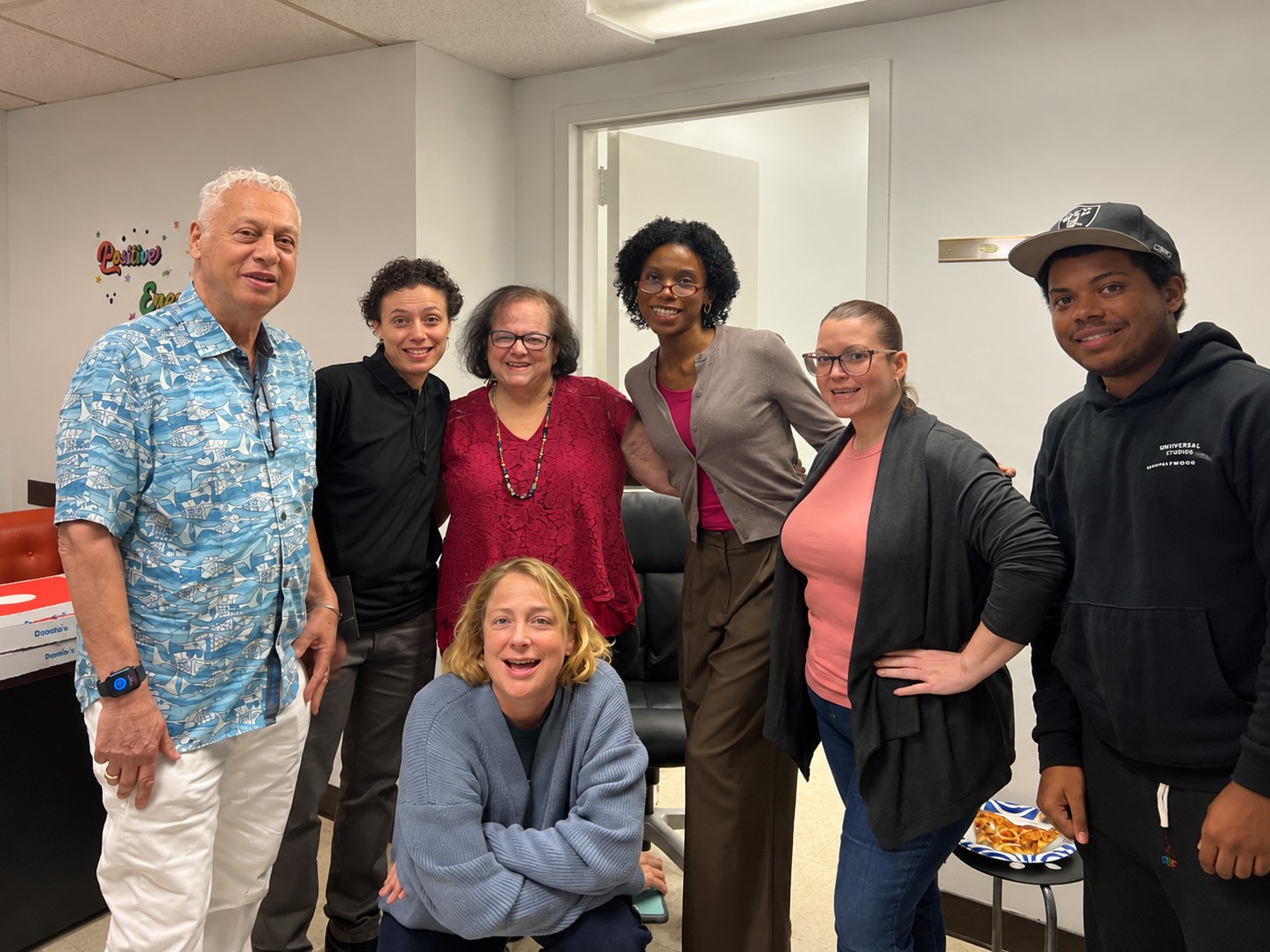
Caption: Reentry@Lehman members and attendees gather during the Pizza Meetup on Sept. 16 in the T3 Building, Room 116. Pictured are, among others, Lehman students Heaven Torres and Gabrielle Navarro, Professor Penny Prince and LaGuardia Community College Associate Professor Cory Rowe. Photo by Najee Brown.
By Najee Brown

Reentry @ Lehman brought 20 students, faculty and community members together on Sept. 16 in the T3 Building for a pizza meetup focused on how incarceration affects families and the support available to justice-impacted
students.

The meetup grew from a request by Lehman students Heaven Torres, a
social work major, and Gabrielle Navarro, a fine arts major, who wanted
a place where justice impacted people could share their experiences, according to Penny Prince, a professor in Lehman’s Music Department and the event’s main organizer.

Navarro spoke about growing up with an incarcerated father and how the experience shaped her relationship with education. She described school as a safe place and said having an incarcerated parent motivated her to pursue her education and make different choices for herself.

Navarro also discussed feeling responsible for other members of her family while her father was incarcerated. She described putting her own needs aside while trying to keep others on the right path.

Thousands of New York youths are affected by parental incarceration. A New York City Department of Health analysis of the 2017 Youth Risk Behavior Survey found that 19% of public high school students, an estimated 36,000 students, reported that at least one parent had served time in jail or prison.

Cory Rowe, an associate professor of criminal justice at LaGuardia Community College, told The Meridian that education can play an important role for incarcerated people and their families.

“Education can set people free,” Rowe said. “Both literally, through legal education, but also by empowering people to pursue new paths that have better outcomes.”

Rowe said the effects of incarceration on families often receive little attention.

“The worst part is, most of the time this is invisible,” Rowe said. “Families, wives, children of incarcerated parents are not really seen by the system. Their stories are rarely told.”

Rowe also said colleges can provide an important space for students who may otherwise feel excluded or misunderstood because of their experiences.

“Creating space is a way of directly confronting exclusion,” Rowe said.

The idea that eventually became Reentry@Lehman began in 2017, according to Prince. She said she encountered a student on her first day at Lehman who was “looking teary and anxious” after being sent from office to office while trying to find help.

“I then realized that there may be many new, reentering and transferring students, some who had been incarcerated, who need our support and we must be there for them,” Prince told The Meridian.

Prince later proposed creating a committee at a Lehman College Senate meeting.

“By the time I got home from Senate, 25 people had emailed me wanting to join,” Prince said. “We now have 50 members.”

The program connects students with help related to enrollment, financial aid and other needs. The Reentry@Lehman website also lists referrals for housing, employment, legal services, personal finances and scholarships.

Despite its growth, Prince said awareness remains a challenge.

“We have our Reentry@Lehman on the Lehman website, yet people still don’t know we are here!” Prince said.

Reentry@Lehman serves both formerly incarcerated students and students whose family members have been incarcerated. Prince said students do not have to identify themselves as formerly incarcerated when applying to Lehman. While she views that privacy positively, she said it can make it difficult for the program to know who may need its support.

Prince said Torres and Navarro, along with Professor Suzette Ramsundar, plan to start a student club this month where students can share their experiences and become involved in issues affecting incarcerated people and their families.

Reentry@Lehman also reached another milestone this year with the opening of its own office in T3-116, the same room where the pizza meetup was held.

“This is important to us as members of society: not just to think of ourselves, but to care for our brothers and sisters,” Prince said.