Music Meets Healing: Aphasia Therapy for Bronxites Launched in Lehman College
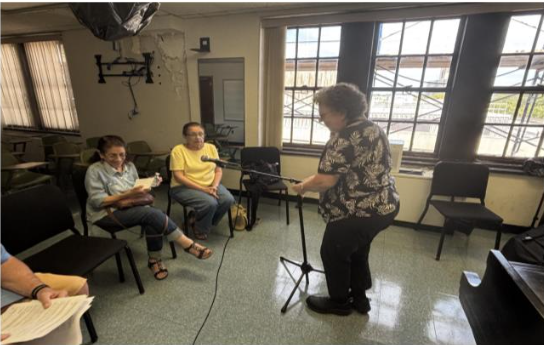
Dr. Tomaino interacting with the elders at Lehman College Music Building.
Image credit: Faith Eguonwu
By: Faith Egwuonwu

On September 10, Lehman College hosted the inaugural session of "Music Has Power® for Aphasia" in Music Building, a weekly initiative offering accessible music speech therapy to local Bronx citizens struggling with language disorders.
"Music taps into intact areas of the brain that bypass damaged language centers," states Dr. Concetta M. Tomaino, executive director and co-founder of the Institute for Music and Neurologic Function (IMNF). "Through rhythm, pitch, and melody, individuals living with aphasia can unlock spoken words and reconnect with their ability to communicate."
Coordinated with the IMNF, the program integrates standard music therapy techniques with speech-language rehabilitation to help local citizens navigate their recovery from strokes and brain injuries.Tomaino explained that while aphasia damages specific language processing centers in the brain's left hemisphere, rhythmic auditory pacing and Melodic Intonation Therapy (MIT) can alter the neural pathways in the right hemisphere. This neurological compensation allows people that have aphasia to find words and articulate phrases through auditory-verbal scaffolding, group singing, and rhythmic exercises.Aphasia is a neurogenic communication disorder that impairs a person's ability to talk, process, and comprehend language, both spoken and written. According to Aphasia Statistics, roughly 2,000,000 people in the U.S are currently living with aphasia, with more than 180,000 United States citizens developing the condition annually. Stroke is the consistent leading contributor, contributing to aphasia for approximately 33% of all stroke survivors.The issue is a pressing priority for the Lehman community. The New York State Department Of Health's Bronx County Health Indicators report from 2021-2024 highlights the severe health equity imbalances in Bronx County, where the stroke mortality rate is approximately 27.9 per 100,000 residents. Additionally, over 24% of Bronx residents are living below the federal poverty line, with 15% of them maneuvering through limited access to full healthcare coverage, institutional underfunding, and mobility barriers that impose major restrictions on access to specialized outpatient care.“Aphasia is not a loss of intelligence; it's a problem of access to the words.” - Adrienne Frohlich, licensed speech-language pathologist
Adrienne Frohlich, a licensed speech-language pathologist with 25 years of clinical experience, provides daily care in acute hospital settings as well as facilitating private practice at Speech Bubble NYC. She noted that family members and the public often misconstrue speech challenges as cognitive decline."Aphasia is not a loss of intelligence," she said. "It's a problem of access to the words. All the same things that you've always known are still there. It's my job as a speech therapist to help you get the words out and express all the things you know." Frohlich highlighted that familiar music taps directly into implicit memory, enabling individuals who struggle with basic sentences to sing complete phrases smoothly. Through established methods such as MIT, speech therapists use pitch and rhythm to trigger speech output from patients. Despite these clinical breakthroughs, systemic barriers often stall long-term rehabilitation for Bronx residents. Local stroke patients regularly struggle with transportation to the medicalfacilities due to the spoken language barrier, restrictive insurance visit limitations, and little to no access to specialized rehabilitation professionals. "One of the most difficult things is finding care and getting the resources that they need," Frohlich said. "If you have communication difficulty, it's harder to find care."Dr. Leslie Grubler, director of the Clinical Education and Clinical Services at the Lehman College Speech-Language-Hearing Center, detailed the integration of music therapy and how it helps with the process of speech recovery for the client. "Bringing music therapy and speech-language pathology together allows us to advance our continuous improvement plan and to look at communication through different professional and inter-professional lenses," Grubler explained. "When we collaborate, we share experiences that may engage communication, memory, emotion, rhythm, social interaction, and participation simultaneously."