Lehman Honors Late Professor’s Legacy with Special Collection Reception
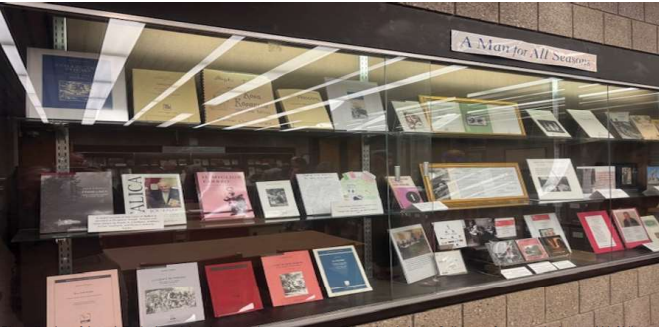
The collection of Joseph Tusiani, acclaimed poet, author, translator, and longtime Lehman College professor, at the Leonard Lief Library.
Photo credit: Francesca Verzivolli
By Francesca VerzivolliOn Friday, Sept. 18, Lehman College celebrated the life and literary legacy of Joseph Tusiani, an acclaimed poet, author, translator and longtime Lehman College professor who died April 11, 2020. The event included a guided tour of the Joseph Tusiani Collection, now housed at the Leonard Lief Library, which includes letters to and from Dr. Martin Luther King Jr. discussing segregation and loss of morals and humanity in America during the 1960s.Besides offering a glimpse into Tusiani’s work as a writer and scholar, the collection shows his enduring connection to both his native Italy and his adopted home in the United States. He was born in San Marco in Lamis, Italy, and arrived in New York at age 23. His connection to the Italian community in the Bronx was a powerful one. According to census data from 2000, approximately 67,100 Bronx residents reported Italian ancestry. Tusiani wrote in both Italian and English and became known as the “Poet of Two Lands.” Through his poetry, translations and teaching, he brought Italian literature to American audiences and vice versa.Professor Kathleen LaPenta, director of the Bronx Italian American History Initiative, said, “The idea that he wrote the Dante book for children is also really fascinating to me, to be able to make classical texts translatable to even young learners.” LaPenta refers to Dante’s Divine Comedy: As Told for Young People, which Tusiani took on retelling in a form intended to be accessible to younger readers. In addition, Tusiani translated major Italian writers such as Boccaccio, Machiavelli and Michelangelo.LaPenta explained that Tusiani also helped make English literature accessible to Italian Americans who may not have had the opportunity otherwise due to a language barrier, broadening the reach of these literary classics and paving a road to connect Italian speakers to English literature.“As long as this [library] building will stand, it documents and immortalizes his career.” — Anthony Julian Tamburri, professor of Black, Race and Ethnic Studies at Queens College
Tusiani was “not ours, not Lehman’s,” said Lehman’s president, Dr. Fernando Delgado; rather, he belonged to an entire community that reaches far beyond the walls of the college. Tusiani joined the Lehman College faculty as a literature and Italian professor after a 23-year career as the chair of the Italian Department at the College of Mount St. Vincent, serving 12 years until he retired in 1983.“He said he liked working at Lehman because he had more students here,” said Dr. Janet Butler Munch, the special collections librarian.Professor Tusiani’s niece, Paula Tusiani-Eng, recounted Professor Tusiani’s colorful and passionate attitude about the world around him, which made him an amazing writer and greatuncle. The curator of the collection, Marguerite Zappa, highlighted Tusiani’s extensive achievements, including becoming the first American to win the Greenwood Prize from the Poetry Society of England in 1956. The collection also contains humbler items, such as Tusiani’s personal dictionary, which he read in its entirety and heavily annotated.For Tusiani, literature was never confined to one language, one country, or one generation. From his childhood in Italy to his life and career in the Bronx, he spent decades building connections between cultures and making literature accessible to others. Today, the Joseph Tusiani Collection allows those connections to continue.As Anthony Julian Tamburri, professor of Black, Race and Ethnic Studies at Queens College, said, “As long as this [library] building will stand, it documents and immortalizes his career.”