by Rosalía Ramírez

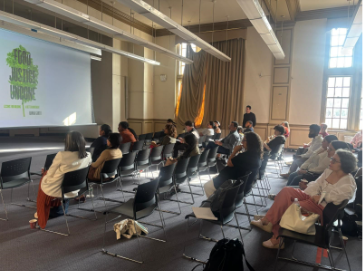
On September 16, professor and cultural anthropologist Dr. Hanna Garth spoke about her book Food Justice Undone: Lessons for Building a Better Movement in the East Dining Hall. This event, organized by Latin American and Latino Studies professor and cultural anthropologist Dr. Alyshia Gálvez, was a continuation of the Bronx Food Humanities Program, an internship program that empowers students from Lehman College, Bronx Community College, and Hostos Community College to combine lived experience, theory, and hands-on work to fight food apartheid in the Bronx.
Galvez chose Garth’s book because she wanted it to shape the intellectual infrastructure of the Bronx Food Humanities program. In the Bronx, there is a glaring issue of food inequality. In the South Bronx, for example, a study from 2022 showed that bodegas outnumber grocery stores 25 to 1. Even though Garth’s work is centered around South-Central LA, Gálvez felt that the work is applicable to the Bronx because it holds a “similar place in the American racial imaginary…These communities are repositories for misconceptions about low-income residents and what they eat.” Galvez praised Garth for being “both loving and critical in her analysis. Her critique exists not to ‘poke holes,’ but to raise awareness of areas for improvement.”
“You could read the book alone, but the real work comes from reading and talking to people about what you read.”
Garth started her talk with an anecdote about when she drove with a fellow non-resident volunteer named Julian through the South-Central LA community. When he spoke, she noticed that her view of South Central and his were diametrically opposed. She said: “As we drove off, I noticed the difference of in what I had been attuned to —specific smells, music, and the vibrant pulse of South Central —and what Julian had fixated on —vacancy, his vision, and misplaced nostalgia.”
She explained that this experience was not an isolated incident, but rather something she kept encountering throughout her ten years working as a volunteer. Organizations stated that they were there to help Black and Latinx residents but built their organizations based on racist assumptions about the people they were serving. Hundreds of millions of dollars were funneled into ineffective food justice organizations which diminished residents' trust in the movement.

While maintaining her critique, Garth also highlighted what she and others had done to combat the power dynamics within the movement. Garth walked the audience through the changes that have occurred over the years because of this work, such as the shift from the term “food desert” to “food apartheid.”

English professor Dr. Tram Nguyen from Hostos Community College commented that while Garth spoke, it occurred to her “that [food] desert and swamp are ‘passive’ ecological states whereas ‘apartheid’ points to human systems and structure.”

During the Q&A, attendees asked questions about topics ranging from policy, pleasure, government spending, intersectionality, performative activism, language, and more. Bronx Food Humanities intern and ambassador Justin Diaz said that he found the event special because he got first-hand knowledge from an expert and an opportunity for communal conversation. He said he considered events like these to be “imperative” in the fight for food justice because, “You could read the book alone, but the real work comes from reading and talking to people about what you read.” Attendees lined up to get their book signed

The event ended with a line of people waiting for their book to be signed by Dr. Garth, who told reporters that seeing students and organizations use her book to improve their work was “just a dream.”