
Meet the Accomplished Lehman Lecturer and Author of the Exciting Young Adult Thriller, ‘’SUN DON’T SHINE’’
There are novels you trudge through, where the characters and stories are just words on a page, and then there are novels by Crissa-Jean Chappell.

The women behind numerous acclaimed novels who write “to make sense of the world.”
By Emmanuel Okoli
There are novels you trudge through, where the characters and stories are just words on a page, and then there are novels by Crissa-Jean Chappell. I’ve read a lot of good books, and I’ve read my fair share of bad ones. What separates the two is the author’s ability to make the story immersive. Authors who can make the characters and their tribulations matter to you. Crissa-Jean has mastered this craft, not just in her stories but in all her written work.
Crissa-Jean Chappell is a renowned author and Lehman professor who has taught in the creative writing department for nine years. A natural creative, Jean grew up imagining fantastical adventures of dragons, pirates, and tentacles. Her ability to vividly curate immersive fantasies is why her work is so highly acclaimed.
In books like ‘’Life Inside My Head’’, ‘’Snowbirds’’, and ‘’Sun Don’t Shine,’’ the Florida native spins tales that take your senses for a spin using techniques like concrete language. This technique allows authors to illustrate aspects you can smell, taste, see, hear, and feel.
I recently had the opportunity to interview Jean. Here’s what she had to say.
What inspired you to start writing?
Crissa-Jean: ‘’When I was little, my dad used to read to me. He would stop at the library on his drive home from work and load up the trunk with stacks of books. Some of my favorites are ‘’Frog and Toad’’, ‘’James and the Giant Peach’’, ‘’Charlotte’s Web’’, and ‘’Anything’’ by Beverly Cleary. After a while, my parents discovered that I was reading the newspaper independently (at first, they thought I’d just memorized my favorite books). Then I started to write my own stories on notebook paper—mysteries about magical ponies and sisters who lived in a treehouse.’’
How long have you taught at Lehman?
Crissa-Jean: ‘’I taught creative writing at the college level for almost twenty years, nine years at Lehman and ten in Miami.’’
How long have you been an author? What is it like?
Crissa-Jean: ‘’My first novel, ‘’Total Constant Order’’, was published by HarperCollins in 2007. Over the years, I’ve seen a lot of changes in the publishing world—specifically with social media. Authors and readers can share a conversation through pictures on Instagram or videos on TikTok. It would’ve blown my mind as a kid when I was mailing fan letters to Anne Rice.’’
Why do you write?
Crissa-Jean: ‘’I write to make sense of the world. In fiction, we have plot and structure, and everything that happens must serve a purpose (while real life can often feel random and unpredictable). Writing is all about connection. It’s amazing when I receive emails from readers saying: “I relate to this character,” or something in the story speaks to them personally. Of course, once a book is published, it doesn’t belong to me anymore. It becomes part of the reader’s imagination, crafted from their memories. And that’s a little magical, too.’’
What do you enjoy most about writing and being an author?
Crissa-Jean: ‘’I can daydream at my desk for hours when working on a story. In a way, it’s also like time travel. I forget about the noisy outside world and disappear inside my head. I listen to the characters’ voices and wait for them to tell me their secrets. I don’t outline my novels until after the first draft, so seeing what my characters will do next is fun and surprises me!’’
What do you dislike about writing?
Crissa-Jean: ‘’My characters are like friends to me. I’m always a little sad to say goodbye to them.’’
How did you develop your writing style?
Crissa-Jean: ‘’I learned much about story structure from my film professors in college (my MFA is in screenwriting, and my Ph.D. is interdisciplinary). If you’ve taken my classes at Lehman, you know I’m a fan of Joseph Campbell's The Hero with a Thousand Faces and how mythology shapes our modern lives. Stories are all about human experience. ’’
What's the most challenging part about being a writer?
Crissa-Jean: ‘’The first draft is just the beginning. Revision can be a big challenge. I tend to write a lot of stuff that eventually I’ll cut out and toss in the “zombie graveyard” file on my laptop. Sometimes, the zombie parts will resurrect into a new draft, but usually they stay dead….’’
How do you deal with writer's block?
Crissa-Jean: ‘’I always tell my students I don’t believe in writer’s block. Of course, that doesn’t mean I don’t sometimes get stuck while working on a new book. If I get stuck, I must consider the hero’s dramatic need. If the hero has a specific goal, you will keep building obstacles and problems that force them to grow and change.’’
What do you want to share with aspirational students who wish to be writers?
Crissa-Jean: ‘’Trust in your voice. Don’t let the robots (I’m looking at you, ChatGPT!) steal your voice away. Storytelling is all about sharing your unique view of the world. That’s your greatest superpower.’’
‘’Framing the Female Gaze’’ Shows the Beauty of Femininity
The 20th-anniversary season of Lehman Stages showcased an event that explored various perspectives of womanhood.

By Amber Castillo The 20th-anniversary season of Lehman Stages showcased an event that explored various perspectives of womanhood. Titled "Framing the Female Gaze," the event featured a series of three immersive plays; ‘’Who's Gaze is it Anyway?", "Ready or Not", and ‘’Adulting.’’ Written and performed by The Bronx Repertory Company. Lehman's signature Art Gallery was transformed into a beautiful environment that showcased vibrant artworks, depicting sexuality and body positivity. The plays captivated the audience with their humor, emotional depth, and authenticity, which helped manifest what it truly means to be a woman. The debate around womanhood and its impact on society is a prevalent topic in today's world. The plays cover many areas, such as the importance of historical figures like Joan of Arc, marriage, religion, and even racial identity. The event had a diverse perspective on what lies beneath the surface of a woman's life. Women have become more vocal and willing to speak up about their struggles and successes, challenging the presence of immense patriarchy where stereotypes are often enforced. Erica Arakawa, 58, the mother of Alexa Downing, the writer of the first play "Who's Gaze is it Anyway?" expressed her admiration for her daughter's vision. She said, "It was really touching to see the influences of her own being. It was exciting to witness the next generation of creative women writers. I started crying; it was amazing to see my daughter be creative and express herself." "Framing the Female Gaze" was an excellent example of how the creative arts can highlight important issues. The play "Who's Gaze Is it Anyway?", explores the different perspectives of women throughout history. "Adulting" portrays the struggles of two adult women trying to connect after one of them deals with the death of a family member. "Ready or Not" delved into the dating lives of women and the challenges they face in maintaining their friendships when drama arises. Each play was more captivating than the last, with the actors bringing unique twists and quirks to their characters. Cleo, the modern woman in "Who's Gaze Is it Anyway?" was vocal and confident in her beliefs and dedication to her family. Mariam in "Adulting" had playful banter with her friend Liz while trying to maintain a dignified demeanor during a funeral. And Rosalita in "Ready or Not" provided humor and drama with her lively and amusing antics. The event was an emotional rollercoaster with the audience on the edge of their seats. Family, friends, fellow artists, and even aspiring actors all came to appreciate the plays. The presence of art, through expression, was significant in promoting growth. AI has become a rampant phenomenon that has affected the way both writers and actors approach their work. Despite the ongoing battle between the rise of robotic intellect and human innovation, the audience came to provide support to a community willing to go above and beyond to express their passion for their craft. Camille Capers, 25, an actor as well as a friend of one of the cast members, emphasized the importance of her stance, stating, "I think TV, film, and theatre are so important. People have an innate desire to create and tell stories, so I just hope that it continues." At the end of the night, the actors all bowed before the audience, and the event ended with a round of applause. The desire to rebel, excel, love, fight, and even embrace one’s flaws has always been prevalent in femininity. Despite the ongoing oppression, women continue to prevail and thrive. In the words of Cleo, "Are we not human first, before anything else?" 
Lehman Theater Presents Romeo and Juliet: A Student’s Review
On the evening of September 13th, 2023, the Lehman community next to Harmony Cafe gathered to watch a much-anticipated play featuring a group of exceptionally talented ac- tors.
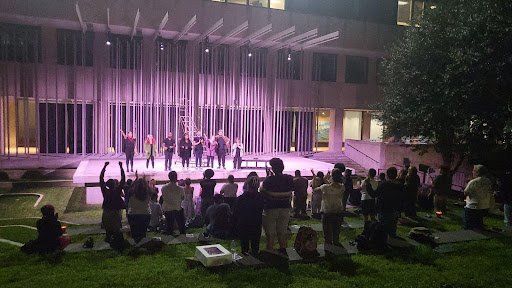
(The cast of Romeo and Juliet: Natasha Collado, Alexa Downing, Hemuel Damis, Ema Garcia, Simran Pal Kaur, AJ Moeller, Jahdiel Rodriguez, Bethany A. Ron. Credit Litzy Acosta)
By Litzy Acosta On the evening of September 13th, 2023, the Lehman community next to Harmony Cafe gathered to watch a much-anticipated play featuring a group of exceptionally talented ac- tors. Many people in the audience were experiencing the Amphitheatre’s unique ambiance for the first time. Gasps and facial expressions filled the air as the characters performed beside them. The festival made remarkable use of the natural surroundings, to craft an immersive experience that made a lasting impression. The excitement was palpable as everyone eagerly anticipated the commencement of the performance. Despite having minimal props, the actors used the steps, stage, and body movement to convey emotion and tell the story. The festival, showcasing Romeo and Juliet, was spectacular. This inaugural production of the Bronx Shakespeare Festival, aptly named "Bronxshakes," marked Lehman Stages’ twentieth season. Romeo and Juliet, a timeless classic, received a performance that did it justice, culminating in a well-deserved standing ovation. Despite the tragic outcome, the exceptional performance left an enduring impact. The actors' ability to utilize their environment and engage the audience was awe-inspiring. Laughter, gasps, and cheers resonated throughout the audience, making us feel like we were an essential part of the play's world. With a diverse cast of talented ac- tors and actresses, the opening performance flawlessly kicked off the festival. The fighting sequences were carefully coordinated specifically to ensure the audience’s safety. Stage manager Julie Peteani's brilliant orchestration of the show turned this moment into an unforgettable experience. In fact, in the crowd, there was a couple who watched the play together, sharing a few laughs, perhaps reflecting on their relationship. Regardless, they watched contentedly as the actors and actresses walked past them, staying in character. "My favorite characters were Ben- volio and Mercutio, the cousins and wingmen," said Lehman student Miguel. The play's resounding success left many uplifted and filled with amazement. Even from a distance, near the trees at the back, every actor’s voice could be distinctly heard. Passersby couldn't resist stopping to sit and watch, at- testing to the captivating nature of the performance. However, despite the windy night, that didn’t stop the mosquitoes from biting, as expected in an outdoor setting. The Amphitheatre has its advantages, and hopefully, students who are upcoming actors and actresses can also utilize this venue. It was indeed a memorable night for all in attendance. The Bronx Shakespeare Festival's "Bronx Shakes" is a must-see for all theater lovers and those who aren’t. The opening performance of Romeo and Juliet was nothing short of spectacular, and I hope for more plays to occur there in the future. 
Rich Dad Poor Dad Book Review
"Rich Dad Poor Dad'' by Robert T. Kiyosaki, a Japanese-American entrepreneur and businessman from Hawaii, offers strategies and tips to achieve financial freedom.
What the Rich Teach Their Kids About Money - That the Poor and Middle Class Do Not! 
The author Robert T. Kiyosaki & Rich Dad Poor Dad book cover from left to right
By Megan Walls "Rich Dad Poor Dad'' by Robert T. Kiyosaki, a Japanese-American entrepreneur and businessman from Hawaii, offers strategies and tips to achieve financial freedom. It also aims to change readers' perspectives on money and its role in their lives. The author also eliminates the stigma of a one-size-fits-all approach to wealth accumulation. As college students, work occupies a significant portion of our time, and with increased income comes the struggles with budgeting. This book is particularly relevant for college students and young adults who face similar challenges, in- forming them about the importance of financial literacy. This includes money management, investing, budgeting, and more to help them overcome financial obstacles. If you want to gain insight into the mind of a successful entrepreneur and learn how to set yourself up for financial freedom, then "Rich Dad Poor Dad’ is a book you shouldn't miss. “Rich Dad, Poor Dad” will be a unique experience for each reader as we all have had different learning experiences. Kiyosaki breaks down the lessons, providing readers with a comprehensive yet simple guide to financial literacy and wealth building. The book is an easy read and a great option for anyone who wants to learn more. However, it presents some ideologies that young adults may not agree with regarding the education sector. The book has eight enticing chapters, and as a student with limited financial knowledge, I found that each chapter taught me something new. Each chapter provided word definitions, study sessions, and illustrations. I have never finished a chapter confused, which is a standout feature of this book. Financial literacy books can seem intimidating, but with “Rich Dad, Poor Dad'', this isn’t the case. The book’s eight lessons focus on breaking down the importance of financial literacy to help people become financially free regardless of their current financial standing. Lesson One examines the role schools play in shaping how we view our path to financial comfort. Lesson Two, entitled “Why Teach Financial Literacy'', highlights how our educational system doesn’t teach students how to handle money and why this is essential for our well-being. Reading Lesson Two helped me understand “Mutual Funds and Financial Aptitude” and highlighted the importance of understanding “it’s not how much money you make. It’s how much money you keep.” In Lesson Six, “Work to Learn Don’t Work for Money” ties perfectly into the topic of college. The author challenges the notion that we should dedicate ourselves to a single area of work once we pick our majors. “Rich Dad, Poor Dad” emphasizes the importance of acquiring diverse skills rather than focusing on one profession. While some may agree that dedicating time to only one line of work is the best move, others prefer not to limit themselves. “Rich Dad, Poor Dad” explains why this is a viable and resourceful option for anyone want- ing to grow financially. These are just a few of the intriguing lessons offered within the book, and it would be worth delving into the ad- ditional six to gain more in-depth knowledge from Kiyosaki. "Rich Dad Poor Dad'' by Robert T. Kiyosaki is a valuable resource for anyone looking to improve their financial knowledge and achieve financial independence. Kiyosaki of- fers a range of other books, such as “Rich Dad’s CASHFLOW Quadrant,” and “Rich Dad’s Guide To Investing'' to further extend the learning experience. Readers can also explore the principles of this book through the board game CASHFLOW, which is available online and on the Rich Dad Poor Dad website Richdad.com. Overall, "Rich Dad Poor Dad'' reinforces the idea that even a little fi- nancial knowledge can go a long way, making it a must-read for those wanting to break out of the common cycle of living just to work, make money, spend money, and repeat. Or what Kiyosaki refers to as the “Rat Race.” 
The Nutmeg’s Curse by Amitav Ghosh Book Review
The history of colonialism has been well-ignored throughout my years of education here in the Bronx and New York City. I am a native Boricua.
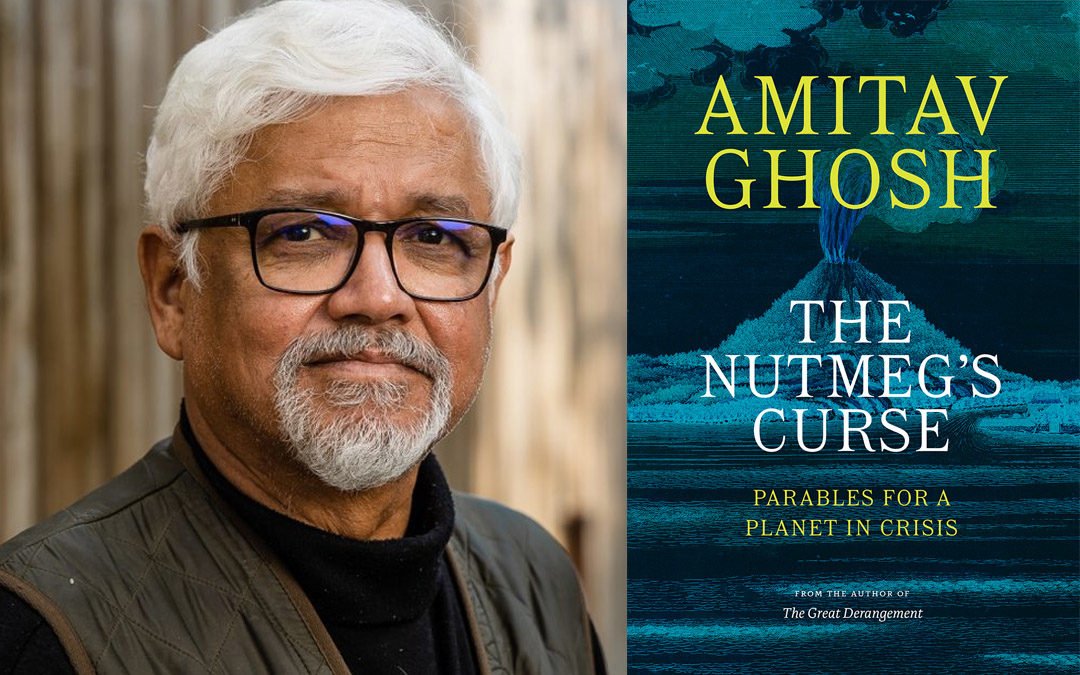
(The Author Amitav Ghosh & The Nutmeg’s Curse cover from left to right)
By Jay-Dani “Ousmane Atheneus Aabid Aakil Fārūq Farzan” Guzmán Sánchez The history of colonialism has been well-ignored throughout my years of education here in the Bronx and New York City. I am a native Boricua. I have experienced colonialism both internally and externally. I grew up singing an anthem that praised Columbus as the dis- coverer of my world. In third grade, I memorized the Puerto Rican national anthem from a textbook and read it back to my teacher. This is a similar experience that NYC voices natives from abroad (mainly non-European countries) tell of their beginnings. Amitav Ghosh, author of The Nutmeg’s Curse, hailed from ancestral India despite raising a family and living in Brooklyn for many decades. Through this perspective, we can form a picture one piece at a time. Flashback to the Banda archipelago in the southeastern Indian Ocean, 1621. The first chapter comes be- cause of the isolation imposed on us in 2020 due to COVID-19. Many individuals managed to be productive, as Ghosh did when he took it upon himself to figure out a mysterious occurrence one night in that distant time. It is known as The Falling of the Lamp. During this time, the Dutch East India Com- pany backed by the navy, decided it would be advantageous for the world if the Banda Islands no longer had native human inhabit- ants and its unique range of farma- ble flora, and thus, through exploi- tation of said resources become even wealthier. One crop they were after was the nutmeg, which was exclusively native to Selamon, the largest out of all the small islands. The nutmeg was a symbol of wealth and status throughout the Silk Road as far out as Europe for centuries. For this reason, the Dutch company wanted to expel or exterminate locals to obtain it. Greed and hubris led to one fateful night in which the mystery of the Falling Lamp took its first life. The lampfall led to a significant yet bizarre event that led the Dutch to go on an all-out shootout against everyone and anyone in their vicin- ity. The tenseness they created made them think they were being attacked. Why would a seemingly insignificant occurrence like this perturb you might ask affect the isolated hours of Amitav Ghosh centuries after? Why is nutmeg, something so small, the centerpiece of the story? Most importantly, what might it tell us? There is only one way to find out, and that's through reading The Nutmeg’s Curse by Amitav Ghosh. I hope to see you on the other side of this thrilling work of literature. Best Regards, J-D.O.A.A.A.F.F.G.S. ~ Review on W. P. (William Paton) Ker’s Classic Book, Epic and Romance: Essays on Medieval Literature (1931)

By Jay-Dani “Ousmane Atheneus Aabid Aakil Fārūq Farzan” Guzmán Sánchez ~For review this month I have picked a book I stumbled upon relatively recently and that has quickly risen to be one of the most foundational texts in my research library and a favorite personal as an inspirational piece. The scholarship on display is sound and has been acknowledged to be of a quality that makes the text a classic. This book has gone on to influence my creative writing process and shape how I think about medieval literature and how it links the more ancient to the relatively more modern. To give some context I should say that this book was born out of the famously academically oriented city-town of Oxford and its chain of world-renowned universities. It was written surrounded by the same circles and people that mainstream classics like J. R. R. Tolkien’s Lord of the Rings were written with monumental names in literature like C. S. Lewis (author of the Narnia Chronicles) floating within arm’s reach. “The story for them is not a thing finished and done with; it is a series of pictures rising in the mind, succeeding, displacing, and correcting one another; all under the control of a steady imagination, which will not be hurried, and will not tell the bearing of things till the right time comes.” (Ker, pg.238) As a writer of fantasy, myself, I can tell that understanding what I do and its relationship to the past and present in these terms helps in understanding a need for restraint in a process that if allowed to grow entirely free will burn itself out. When writing creatively, fantasy is not the least, some limits must be imposed, spatial-chronological and limits between the possible/impossible borderline. Nonetheless, the constraints are not like those placed upon solid objects, but fluid like a liquid that reshapes itself as needed as it moves from one container to another. Being said, it is interesting to say that restraint is not only an advisable element in the writing process but rather instrumental to it, for a story is akin to a picture from a camera; an event frozen in time with clear, well-defined edges for it is yet impossible to build a camera that can photograph the entire world within one single lens. “One function of the Romantic School… is to make an immediate literary profit out of all accessible books of learning. It was a quick-witted school and knew how to turn quotations and allusions.” (Ker, pg. 309) I must make a note here, that “romantic literature" is different from “Romantic Literature.” The former, written with a minuscule “r” refers to the love stories we well know, the latter, written with a majuscule “R” refers to the 19th-century movement that succeeded the 18th-century Gothics and is known for its staple presentation of the world in its natural state, perhaps in response to the then rapidly industrializing world. “A Romance,” however, often refers to fairytale-like medieval stories blown to literary size. Now, with that out of the way, I shall say that this movement is a descendant of a widely branched family tree, as Professor Ker himself explains. As the title of the books attests, the Romantic Movement owes much to the works of literature of previous ages, significantly, the Epic poetry studied in its day. An Epic poem is also a great grandparent of one of our favorite literary formats today, the Novel. One of the most obvious differences between a Novel and an Epic poem is that one is prose, and one is poetry. But the similarities are equally hard to miss, for they both tell a continual story throughout hundreds of pages, sometimes over many successions of books all centered on one single character, event, or theme. For people who have a literary diet that is strictly defined by the literature of today, it would be easy to take for granted that not all literature functions thus. Ancient Epics for instance are almost always a compilation of hundreds or even thousands of stories synthesized into one narrative. Something akin to that would be like taking a similar amount of famous lyric songs and using them to write one continuous story. Romantic literature of course exploits what ancient and medieval literature had to offer in all manner of creative and intelligent ways that managed to take old stories and tell them anew as “pictures rising in the mind, succeeding, displacing, and correcting one another” With this said, the literature of today does not exist in a vacuum, apart and different from what has come before, but stands and grows out of what has been left behind by older, literary oriented generations. The book is great, it allows us to have this kind of conversation and discuss a heritage that, though veiled from view, exists and is as alive as ever. Having read this book multiple times, I can vouch for the value of its contents: there are plenty of more odd pearls to be found in it. For those interested in rediscovering this classic there is good news… first, this book is so old that it is in the public domain, second, due to that fact free copies can be found on the internet in the form of PDF and Amazon Kindle for free, and last, for those who want a paper copy immediately, several are to be found in the Leonard Life Library. Enjoy your reading and stay well.Earnestly,J-D.O.A.A.A.F.F.G.S. ~
Review of Call Me by Your Name

By Jay-Dani “Ousmane Atheneus Aabid Aakil Fārūq Farzan” Guzmán Sánchez ~"Call Me By Your Name" introduces a romance story incorporating the now-known LGBTQ+ community, in a familiar yet impactful manner, even for those outside that same community. To unpack this perspective, I shall explain that I am not a part of the LGBTQ+ community. There are, however, people in my circle of friends and family who do identify in this way, and to me, they are just like everybody else. With my assumptions established, it's worth noting the significance this book holds for me. I was first introduced to it during my senior seminar in English at Lehman College, a place that holds particular significance, as the alma mater of the author himself, André Aciman. It's truly remarkable to consider that this global sensation, which has touched the lives of countless individuals and even spawned music and a film adaptation, traces its roots back to our very own community.As a book enthusiast, I find myself cautiously echoing Aciman's words when he asserts, “People who read are hiders. They hide who they are. People who hide don’t always like who they are.” (Aciman, pg. 114). While I can't claim this sentiment to be a universal truth, it undeniably holds significance to comprehending the intricate narrative that unfolds within these pages and in the unraveling of the people steering this cautionary tale forward. The two central characters, Elio and Oliver, are both products of academically driven families and have embedded themselves deeply in the very books that define them, too. As Jewish homosexual men navigated the terrain of the 1970s, they witnessed the continued struggle for civil rights, including LGBTQ+ rights. It was a time when homosexuality was gradually becoming more visible and accepted, but discrimination and prejudice persisted. The AIDS epidemic, although not yet widely recognized, would soon become a major health crisis. Yet, not everything in their lives is veiled by the cloak of history or the separate landscapes we and they call home. In a culture that places premium value on logos [logic] for reasoning, we often dismiss the primordial realm of pathos [emotion] as irrelevant, and at times, even contemptible. However, frequently, the distinction between "comprehending" something and failing to grasp it altogether hinges on the presence or absence of understanding within one's own heart. In this logo-centric world, we are prone to disregard the significance of pathos [emotion], yet it holds the key to unlocking deeper layers of meaning in the stories we are prone to encounter. Thus, our ability to comprehend often pivots on the abundance or scarcity of what resides in one’s heart. As Elio reflects in the book, "I wish I had one friend I wasn’t destined to lose" (Aciman, pg. 180). He goes on to caution us, "We rip out so much of ourselves to be cured of things faster than we should that we go bankrupt by the age of thirty and have less to offer each time we start with someone new. But to feel nothing so as not to feel anything—what a waste!" (Aciman, pg. 217). This story overarches the importance of feeling your emotions, even pain. Those who do not feel pain are not truly alive. They belong to the realm of the living dead. This existence is a test, and those who refuse the test meet their end prematurely. This is true for all. Wisdom is to be had in every story, not just our own… we need to be bold enough to see the lessons. In the landscape that Elio and Oliver navigate, their divergent paths offer profound insights, Elio grapples with an elusive dream, much like his identity, concealed but not forgotten. Conversely, Oliver forges a fulfilling existence, embracing family, and contentment. Their journeys serve as a poignant reminder that life often presents unexpected twists and turns. What we should aspire to, like Oliver, is to find purpose and fulfillment in the ever-changing landscape of living. Elio and Oliver remind us of the resilience needed to navigate life's uncertainties and reveal that, in the end, purpose transcends the goals we set, as these goals are ever-changing while purpose remains a timeless beacon guiding us forward.Best Readings,J-D.O.A.A.F.F.G.S. ~
Episode 3 of The Last of Us Drastically Changes Source Material
By Nicole DeVincentis
Episode 3 of HBO’s The Last of Us premiered Sunday, January 29th, and shocked fans of the original video game source material with a heartfelt alteration to the ‘Bill and Frank’ storyline.
In an apocalyptic zombie-ridden world, the adaptation offered a beautiful rendition of the inspiring love story between its side characters ‘Bill & Frank’ that the video game merely alludes to. Original fans of the video game have expressed varied reactions to the show’s decision to change the source material as this choice unequivocally eliminated the possibility for further development for its characters Bill and Ellie.

Spoiler Alert:
this change was illustrated in the episode’s finale with both characters, Bill & Frank, choosing to take their lives, unlike the video game which only saw Frank’s untimely death. Some distressed fans felt the decision to change this storyline will hinder the show’s ability to display the progression of the relationship between its main characters Ellie and Joel.
Executive producer Neil Druckmann said in Episode 3’s Inside the Episode, “When should we deviate and when should we come back? If it’s kind of the same or worse, we stay where the game is. If it’s better we deviate.” According to Warner Bros. Discovery, this third episode brought the series to a whopping 21.3 million viewers, tying it with other renowned HBO productions including House of the Dragon and Euphoria. HBO’s Inside the Episode also featured Australian actor, Murray Bartlett, playing the character of Frank. Bartlett said in response to a question regarding his reaction to the episode, “My first reaction to the episode was surprise. It was this unexpected, beautiful love story in this bleak world.”
Among new fans of the adaptation, some have been quoted dubbing the series’ third episode as HBO’s magnum opus. The show used a full 80 minutes, longer than its second episode but shorter than the first, to depict the heart-wrenching love story from the couple’s wary first encounter to their bittersweet final moments. Between the episode’s first and final acts, Druckmann displayed a blossoming and utterly real relationship that saw Bill’s character grow from paranoid and asocial to a loving, protective husband.
Lehman student and (non-game player) avid show-watcher Angela Williams commented, “I really did enjoy the episode. I think it did a good job at highlighting the difference between the show and the game. For game players, the beauty of the game is survival and winning, but for people watching the show, there has to be more. There can’t just be meaningless violence every episode. What episode 3 accomplished was providing hope to a hopeless situation.”
While opposition to the series’ decision remains valid, it is quite clear that an overwhelming majority of fans embraced Druckmann’s radical choice to embellish the already existing storyline and resolve it in a fashion that stood true to Bill’s ‘new’ character. Now it is up to showrunners to continue demonstrating the virtue of their choice in further episodes.
Afghanistan War Vet Pens Touching Tribute to Late Brother
By Michael Omoruan

A photo of Scott DeLuzio(L) and Steven DeLuzio(R). Courtesy of SgtStevenDeLuzio.com.
Everyone remembers where they were the Twin Towers fell on 9/11. Without exaggeration, it is a day that we, as a nation, will never forget. Scott DeLuzio definitely won’t. The day inspired him to serve our country by joining the national guard which eventually led to him joining the war effort in Afghanistan.
His parents weren’t too thrilled to say the least since his younger brother, Steven had enlisted in the Vermont Army National Guard “as a part of A Company 3/172 Infantry Regiment”, Steven notes in Surviving Son, a gripping, intimate book The Meridian was fortunate to receive an advanced copy of.
In it, Scott details the early years spent with and his brother’s time spent overseas serving our country along with coming to terms with his death on August 22, 2010 during Operation Enduring Freedom, according to the Military Times. Despite the harsh reality he was faced with and challenges he endured, he was soon able to find it in himself to push forward.
The two were inseparable growing up. They would re-enact their favorite scenes from the 1986 dog-fighting classic Top Gun with a spoon and couch cushions and visit army bases with their parents. Both of which instilled respect in them for those who served at an early age.
It wasn’t too long after that they begin attending baseball and hockey games. In one memorable instance, after the DeLuzios’ Boston Bruins laid waste to the Montreal Canadiens, Steven’s bellowing of “USA! USA!” was powerful enough to get a stadium chock-full of Bostonians to join in unison after exiting their seats.
Scott’s book was released on August 30, 2021 and was based on journal entries he would write shortly after returning home. In an effort to let out what he experienced while also giving his children and also others an idea of what life was like for him, he began to write what would eventually become the finished piece.
Despite the dark and heavy subject matter, Scott packs in plenty of pathos and humor which was unexpected but necessary at points. When asked about this in an exclusive interview with the Meridian, he stated that he likes to joke around. “I think I got that from my brother. I recognized that part of the reason for writing this was so that we could understand who the person is behind this name and picture that you might see in the newspaper or television. And his personality was a funny personality, he was just a funny guy.”
Being released just as the country and the world at large seems to reverting back to normalcy post-pandemic, the book is also a great resource for overcoming what may seem insurmountable obstacles.
When asked on having any trauma or PTSD during the height of the pandemic, surprisingly Scott, who is also the host of the Drive On podcast where he talks with veterans to inspire hope and resiliency, stated that one of the first actions taken by veterans who may be afflicted is to self-isolate and limit going outside.
“One of the strange things was when all the lockdowns and this whole thing started with the pandemic started last year. I looked around and everyone seemed like there were panicking and I was like ‘Should I be acting any different right now? Because this is how I normally am. When people were talking about 6 feet, I was like ‘Is that it?’
Also the founder of Amplify Plugins, an online company that provides plugins for almost everything from digital downloads to restricting purchase of products someone’s store may have in certain countries, Scott gave some great last words of wisdom for those that may need it. “When there’s something you want to do, even though it’s a hard and challenging thing to do, you figure out a way to do it. I think everybody has it in them. It would take a lot of failures. I had plenty of my own with learning everything that I did. But all those failures, you learn from and you get better from them.”
Surviving Son is available for purchase now on Amazon in Kindle, hardcover, and paperback

Cyberpunk 2077: Its Rise to Glory and Immediate Destruction
By Ryan Pullido, Staff Writer
In 2018 in a gaming trade fair called “The Electronic Entertainment Expo”, otherwise known as E3, the developers of CD Projekt Red unveiled the first glimpse of gameplay for Cyberpunk 2077. With bated breaths, excited gamers are enthralled looking at the stage salivating at the game they are witnessing. A beautifully crafted world filled with vibrant and unique NPC’s. Celebrities such as Keanu Reeves, Grimes and ASAP Rocky added fuel to the hype of the game. Magazines such as Kotaku heralded the game as the most anticipated title of the century. As the days counted down towards the release of the game the hype reached its peak. But when gamers finally got their hands on the product, they found an entirely different game from the trailers.
Cyberpunk 2077 was first announced way back in 2012. It was in development hell for seven years before it was finally released on December 10, 2020. By comparison, Final Fantasy XV was first announced back in 2006 in a different title (Final Fantasy versus XIII) but was finally released in November of 2016. It was stuck in development hell for 10 years and the concept of the game changed dramatically throughout those years. But when the final game came out, although the game felt and looked different from the previous demos and trailers, the game felt complete. The same can’t be said about Cyberpunk 2077.
In the E3 2018 demo, CD Projekt Red showcased Night City as a vibrant and alive world. NPC’s were going to have their own unique actions depending on the time of day with unique interactions. According to CD Projekt Red developers they aim to make “the most believable city in any open world to date.” It was reminiscent of the NPC’s from Grand Theft Auto IV. They were well fleshed out too, taking out their umbrellas when it was raining, dropping their grocery bags when the players bumped into them, etc. The city, albeit depressing, felt very much alive. However, when the game debuted in 2020, the city felt desolate compared to the 2018 demo. The vibrancy of the NPC’s that was previously shown weren’t there. The unique interactions that were promised were nowhere to be seen in the final iteration of the game. Night City and the surrounding Badlands feel empty because of this which is frustrating because the locations were beautifully crafted.
The combat system in the game was not revolutionary, as it copies the formulas of most first-person shooters; run and gun. However, there are some fun aspects of the game that differed from other RPG games; such as the Beat on the Brat mission (which tried to recreate boxing by forcing players to fight opponents in fist fights.)
The only reputation system implemented in the game is “Street Cred.” This system, however, does not affect your reputation with any of the affiliated factions in the game. This, in turn, makes the player not care about the other groups from the game aside from the main characters.
Although the 2020 launch of the game was plagued with bugs and broken systems, one of the things that CD Projekt Red nailed was the story development and how the character developed throughout the game; which created a lasting impact on the players. According to screenrant.com writer Nicole Rennolds, she writes “Some of Cyberpunk 2077’s best moments are the personal connections with V’s friends and allies, while others involved questlines that force players to grapple with morality, religion, abuse, and exploitation.”
For all its faults, Cyberpunk 2077 is still a gem. The story tackles a heavy issue that a lot of people can relate to and that is your mortality and identity. The main core of what makes Cyberpunk 2077 good is its gripping story, and if you are a person who can overlook the flaws of a game and be enthralled by a story then go buy this game. Furthermore, CD Projekt Red aims to better improve the game by additional content and fixing the bugs in the game. In a public statement released on January 13, 2021, CD Projekt Red stated, “We are committed to fixing bugs and crashes and will continue to work and improve the game via future updates to make sure you are enjoying the game regardless of the platform.” On February 15, 2022 they made good on that promise by releasing Patch 1.5 which fixed the majority of the bugs as well as adding new features and content on the game. Without a doubt, the Cyberpunk 2077 2020 launch was a catastrophic failure and it will most likely be remembered for that launch. But there are players who have put their trust in CD Projekt Red and the devs intend to not make the same mistake twice. Overall, with this recent patch and more content on the horizon Cyberpunk 2077 does deserve another chance at the spotlight.